

What is a Requirements Specification?
Definition:
The so-called requirements specification is indispensable for every project. This document describes which requirements, functions, tasks, or other framework conditions must be met to achieve the overall project goal. Especially when introducing or developing software, it is negligent not to create a well-structured and complete requirements specification! The requirements specification is ALWAYS created by the client and is then transmitted to the contractor.
What is a functional specification?
Definition:
The contractor creates the functional specification based on the requirements specification received. It should describe exactly HOW the client’s requirements will be solved. The functional specification gives the customer the opportunity to compare different contractors, service providers, or vendors. This is the only way to achieve the necessary transparency for contract negotiations as well as financial security and the seamless implementation of specifications.
Differences between Requirements Specification and Functional Specification
In a nutshell:
The requirements specification is created by the client.
The functional specification is created by the contractor on the BASIS of the requirements specification.
By performing a final comparison of the requirements and functional specifications, it is possible to establish a watertight contract.
Content and Structure
What components should the requirements specification include?
- Company questions for the provider
- Technical and functional requirements
- Required interfaces
- Tools and methods used
- and much more.
How should the requirements be formulated?
Be sure to use closed-ended questions! Example:
Is there an interface to our current CRM?
The desired and shortest answer from your perspective (the client) is a simple YES. Since a requirements specification can quickly contain hundreds of different points that all need to be answered depending on the project size, it is better to ask precise questions to get precise answers.
Even better, define set response options! Example:
S = Included in standard and can be implemented directly
K = Small adjustment of less than one day
G = Large adjustment, several days required
N = Implementation is not possible
etc.
Let your creativity run wild; this is the only way you can efficiently compare different offers in the end. The weighting of your requirements is just as important! Create a suitable scale for this as well, e.g., from A – Z (A = Must have, Z = Nice to have).
How many criteria does a professional requirements specification usually contain?
A distinction must be made here as to whether the project affects the entire company or only individual departments. When introducing, for example, a new forwarding software with all processing functions for a company size of approx. 1,000 employees, you quickly reach 1,500 to 2,200 criteria. If you look at “only” a single department with approx. 30 employees, it still quickly reaches around 750 criteria.
That’s quite a lot of effort, and without help, this usually takes several weeks or months… how can it be made easier?
Requirements Specification Templates
Many contractors (software providers, service providers, etc.) have their own requirements specifications and make them available to customers. But do you really want to trust that all your requirements are included here? Probably not…
Instead of a template, you could also hire a consultant to create an INDIVIDUAL requirements specification with you from scratch. You can guess that this approach is very expensive, time-consuming, and not very efficient.
The best solution is a requirements specification template that fits your project while being individually customizable! You don’t have to reinvent the wheel; many projects are similar in their basic requirements and therefore ALWAYS include the same criteria. Furthermore, you ensure that nothing has been forgotten and save yourself time and money.
But where do you get this template? The answer is clearly from an independent and neutral consultant. They will help you define the individual requirements of your project in a targeted and watertight manner.
Instead of several weeks or even months, a requirements specification with approx. 2,000 criteria can be developed within 3-5 days!
Requirements Specification Example
Here you will find an example for selecting a Warehouse Management System (WMS) from our templates:
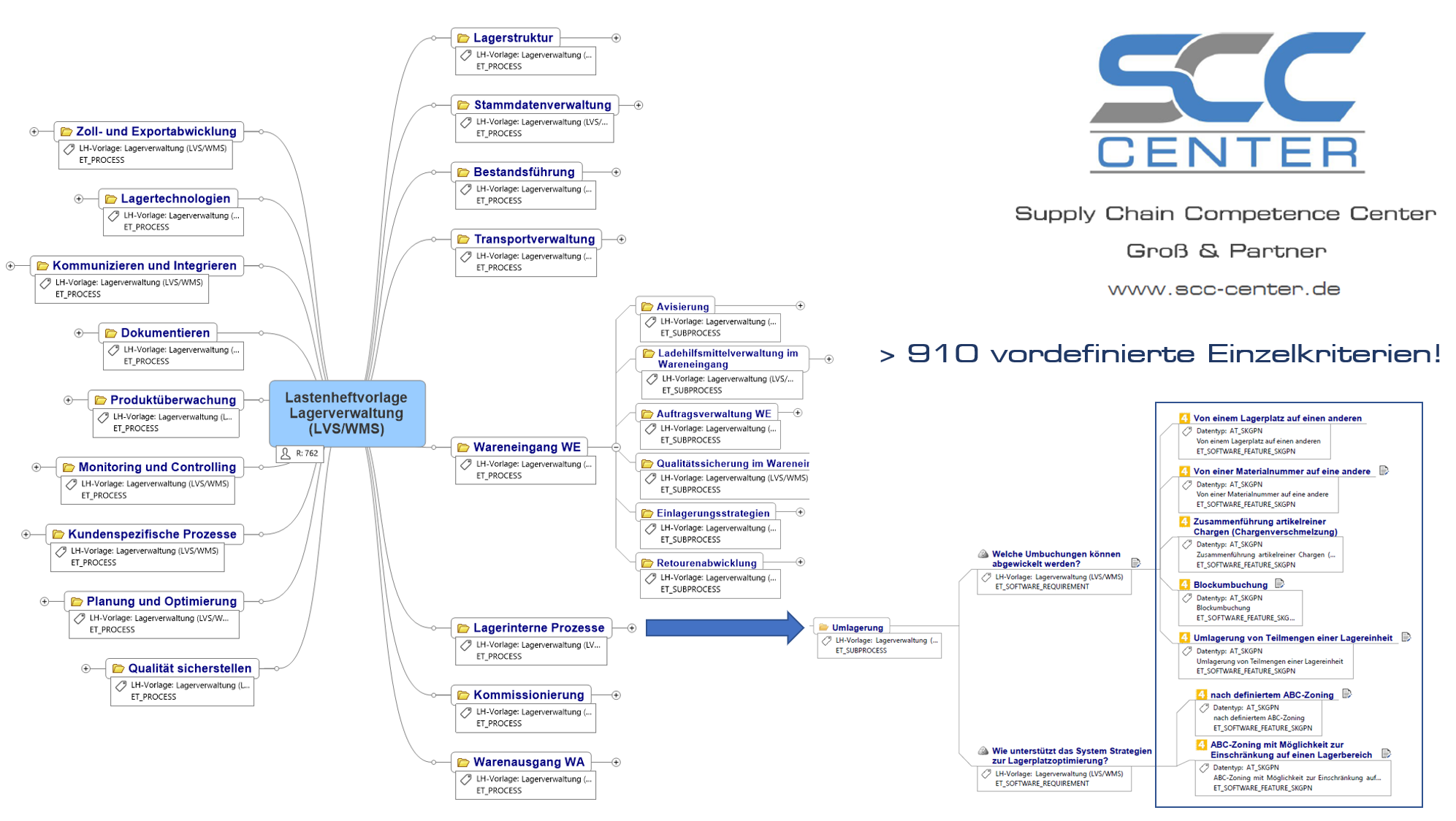
The investment is worth it, as forgotten criteria and functions are quickly recorded by the contractor as a change request and can cause your project costs to explode. A good requirements specification template with professional support gives you the necessary (financial) security; otherwise, you run the risk of being “played” by the contractor.
Don’t forget: The contractor/service provider carries out countless projects a year and knows exactly which details are often forgotten in the requirements specification…
Software Requirements Specification Creation
Due to a lack of solutions in this area, many companies use Office programs like Excel or Word. Mind map programs such as Mindjet, which allow you to visualize your catalog of requirements, are a good idea.
In our view, the best solution is a project platform through which both the creation of the requirements specification and the entire tendering of the project can be carried out. That is why we rely on the IT-Matchmaker. Here you will find over 1,600 software providers and solutions with company profiles, references, and reference projects. The platform also offers the possibility to compare different software providers based on over 2,700 defined attributes.
Conclusion:
The requirements specification is indispensable; anyone who does not create one or forgets important requirements actively contributes to the failure of the project. Only through the comparison and systematic control of requirements and functional specifications can you achieve the necessary financial security and transparency to make different offers comparable with each other!
Further Links and Articles:
https://www.computerwoche.de/a/gescheiterte-it-projekte,2546218